Trường Hóa và Khoa học sự sốnghttps://scls.hust.edu.vn/uploads/scls/logo-dhbk-1-02_130_191.png
Thursday - 23/07/2026 18:18
The two Chemical Engineering Departments in Vietnam and the Republic of Korea aim to develop dual-degree programs, expand student exchanges and conduct joint research, strengthening their international publication capacity and academic standing.
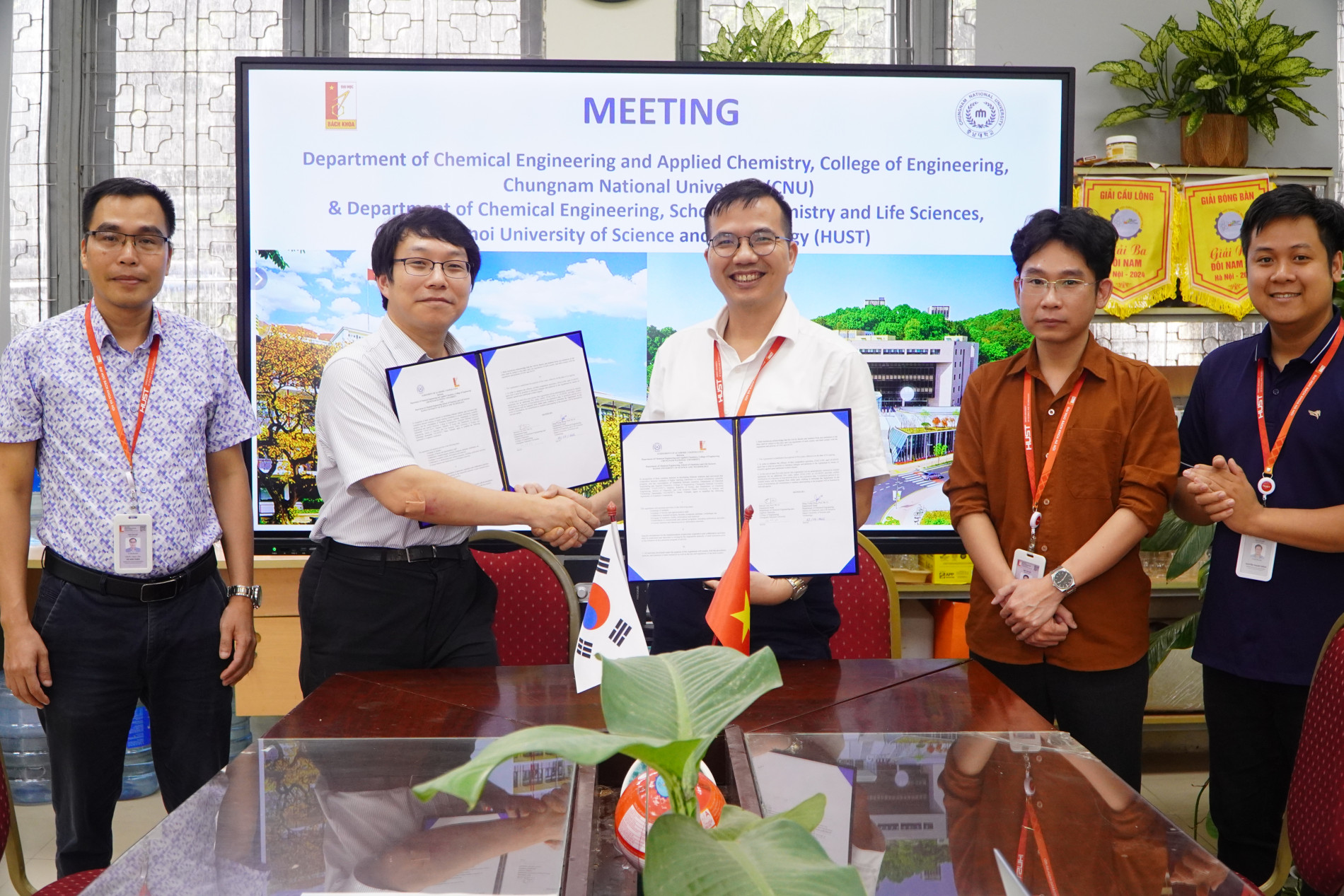
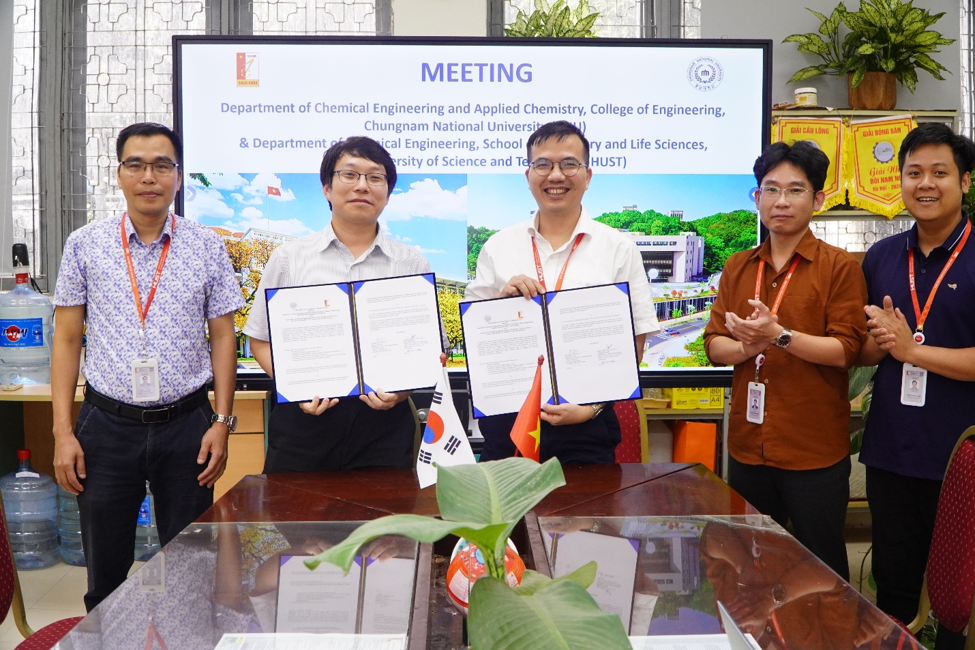
Representatives of both sides shake hands following the signing ceremony.
On July 23, the Department of Chemical Engineering, School of Chemistry and Life Sciences, Hanoi University of Science and Technology, signed an academic cooperation agreement with the Department of Chemical Engineering and Applied Chemistry, College of Engineering, Chungnam National University, Republic of Korea.
The agreement was signed by Prof. Dr. Jaewon Lee, Head of the Department of Chemical Engineering and Applied Chemistry at Chungnam National University, and Assoc. Prof. Dr. Dang Trung Dung, Head of the Department of Chemical Engineering at the School of Chemistry and Life Sciences, Hanoi University of Science and Technology.
Under the agreement, the two departments will promote exchanges of students, faculty and administrative staff; collaborate on research projects; and jointly organize lectures, conferences, professional discussions and other academic programs. They also plan to exchange academic materials, scientific information and course credits, while expanding access to shared academic networks.
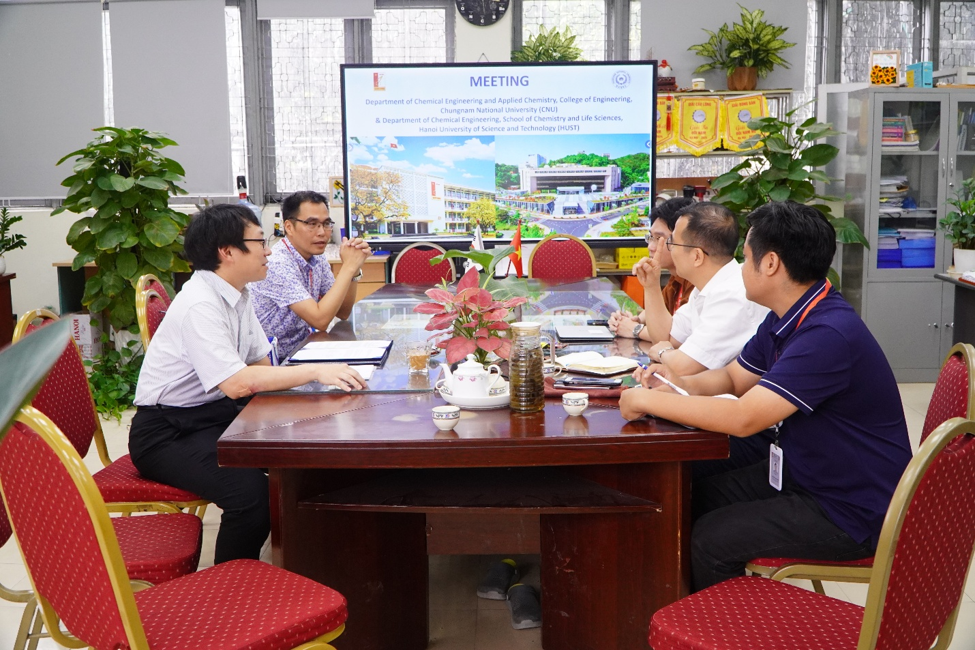
An overview of the meeting between the two parties.
A major focus of the partnership is the development of joint programs at the undergraduate, master's and doctoral levels. At the undergraduate level, the two sides are discussing a dual-degree or 2+2 program in which students would study in both Vietnam and the Republic of Korea.
At the master's level, a 1+1 model is under consideration, giving students access to the academic environments, laboratories and supervisors of both institutions. At the doctoral level, the two departments plan to develop a four-year joint program combining credit requirements with research, scientific publications and dissertation work under the supervision of faculty members from both sides.
In addition to long-term programs, the two departments plan to expand short-term exchanges for graduate students. Participants may attend summer or winter courses lasting two to three weeks, conduct experiments, join research group meetings and discuss specialized topics directly with professors.
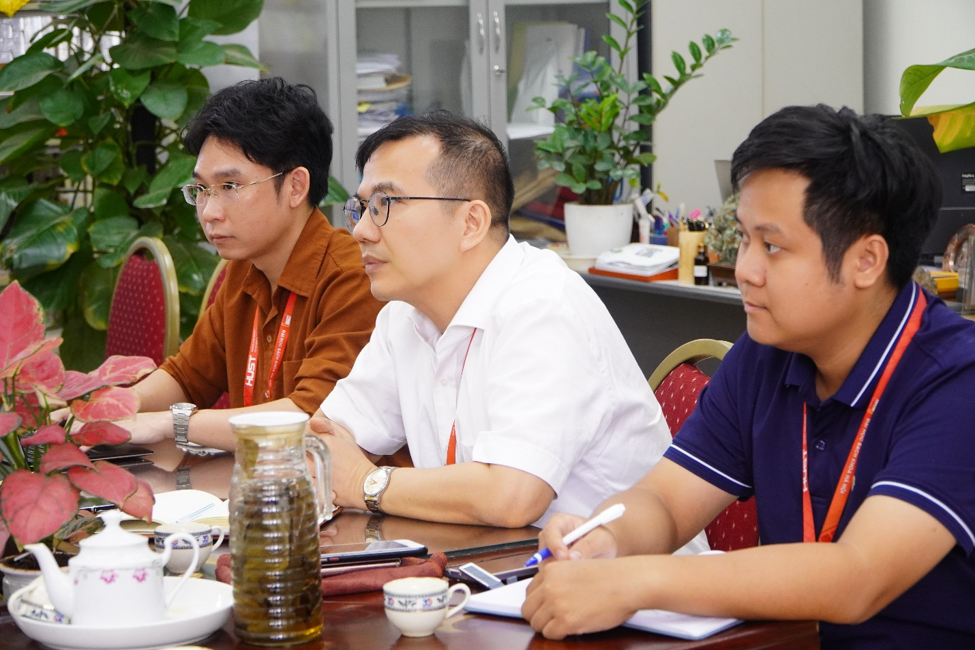
Assoc. Prof. Dr. Đặng Trung Dũng, Head of the Faculty of Chemical Engineering, School of Chemistry and Life Sciences, Hanoi University of Science and Technology (seated in the center).
These activities are expected to familiarize students with an international research environment, provide access to new research methods and equipment, and support the development of master's theses and doctoral dissertations jointly supervised by faculty members from the two institutions.
The agreement builds on cooperation developed in recent years. Faculty members from the Department of Chemical Engineering at Hanoi University of Science and Technology have delivered online lectures to students at Chungnam National University. Professors and researchers from both institutions have also made reciprocal visits to Hanoi and Daejeon to discuss research directions and identify opportunities for collaboration.
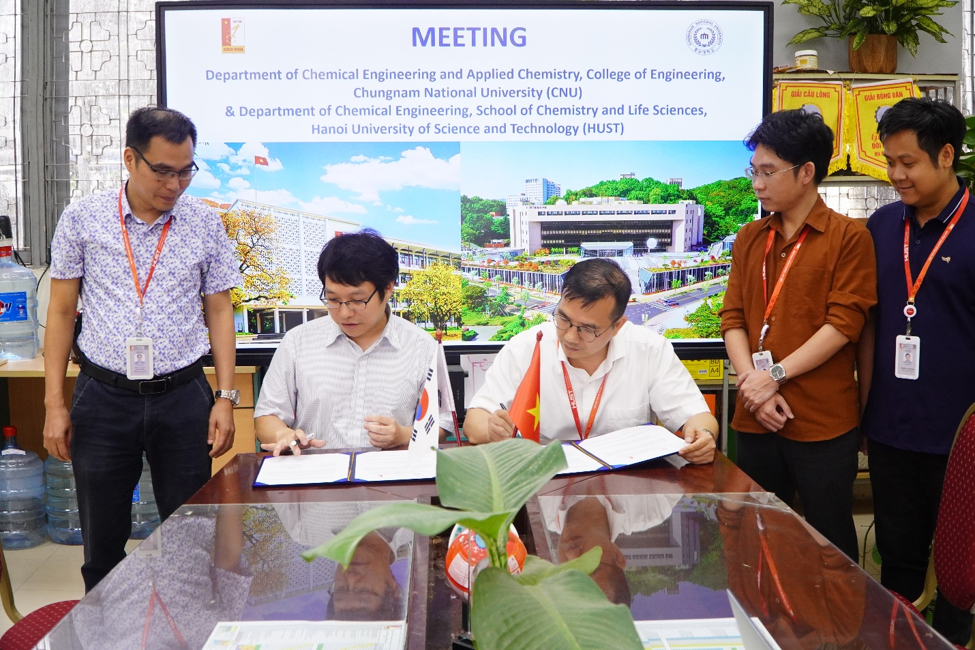
Representatives of both institutions formally sign the cooperation agreement.
Building on these initial activities, the two departments aim to turn individual connections into a structured partnership. Joint supervision of graduate students, the formation of collaborative research groups, shared laboratory resources and international co-authored publications have been identified as key outcomes.
The partnership will also enable researchers from both sides to address interdisciplinary topics, connect fundamental research with practical applications and improve their ability to participate in international research projects. For students, studying in two academic environments can strengthen professional expertise, language skills and research networks from an early stage of their careers.
The collaboration aims to expand international education, increase joint publications, and enhance the academic standing of Chemical Engineering at Hanoi University of Science and Technology.
As internationalization, publication quality and collaborative networks increasingly shape the reputation of higher education institutions, the agreement with Chungnam National University will do more than expand learning opportunities for students. It is also intended to strengthen research capacity, promote high-impact scientific outputs and enhance the regional academic standing of Chemical Engineering at Hanoi University of Science and Technology.