One of the programme’s key priorities is to strengthen connections among circular-economy-related topics, enabling learners to approach the subject through a clearer, more coherent, and more interdisciplinary learning pathway.
Rather than treating the circular economy as a stand-alone topic, the programme places it in relation to environmental issues, resources, energy, technology, policy, and governance. This approach helps learners understand the transition from a linear economy to a circular economy within a broader context and in relation to the practical requirements of sustainable development.
Connecting circular economy content through an interdisciplinary learning pathway
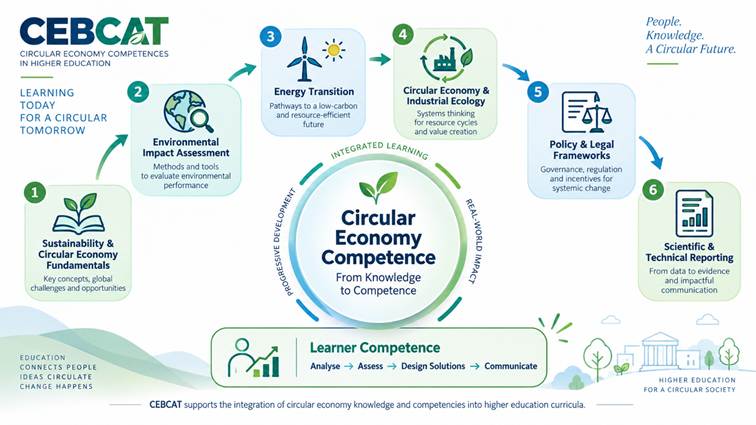
The content developed under CEBCAT ranges from the fundamentals of sustainability, environmental limits, and circular economy principles to environmental impact assessment tools, energy transition, industrial ecology, policy, and scientific reporting skills.
Along this pathway, learners are first introduced to fundamental issues related to the environment, resources, and sustainable development. Environmental impact assessment content then provides them with tools to identify, measure, and analyse impacts arising from production and consumption activities.
The programme subsequently broadens the perspective through energy transition topics, including renewable energy, reduced dependence on fossil fuels, and green hydrogen. These topics are linked to the circular economy through the goals of improving resource efficiency, reducing emissions, and enhancing the efficiency of production systems.
From an applied perspective, sector-specific circular economy and industrial ecology content introduces learners to solutions such as utilizing waste and by-products to create value-added products, optimizing material and energy flows, and strengthening linkages among production processes.
Alongside technical and technological solutions, the programme also connects topics related to legal frameworks, policy, and institutional capacity, helping learners understand that the transition to a circular economy depends not only on technology but also on appropriate governance mechanisms and supportive policy environments.
Modules on scientific and technical reporting further strengthen this learning pathway by developing learners’ ability to synthesize evidence, analyse data, present results, and communicate solutions in a clear, scientific, and evidence-based manner.
From specialised topics to a coherent approach to the circular economy
A notable feature of CEBCAT is its emphasis on making the relationships among circular-economy-related topics across different modules more explicit.
Through this approach, learners can connect a sequence of issues ranging from identifying environmental challenges and assessing impacts to analysing technology and energy options, considering opportunities for resource circularity, evaluating policy dimensions, and presenting scientifically grounded solutions.
As a result, the circular economy is approached not merely as a concept or an individual topic, but as a way of thinking that connects multiple disciplines.
This is particularly important for postgraduate students, whose learning is expected to extend beyond the acquisition of specialised knowledge to include the ability to analyse, evaluate, synthesise, and apply knowledge to real-world problems.
Strengthening interdisciplinarity and practical application within the programme
The development of content under CEBCAT contributes to enhancing both the continuity and interdisciplinary nature of circular economy topics within the training programme.
Environmental issues are connected with resource and energy use; technological solutions are considered within policy and governance contexts; waste is viewed not only as something to be treated but also as a potential resource; and reporting skills help transform analytical results into information that can be used in research, management, and practice.
These connections enable learners to develop a more systemic understanding of the green transition while strengthening their ability to integrate knowledge from different fields to analyse and propose solutions to challenges related to sustainable development and the circular economy.
From project outcomes to long-term impact
One of the key values of CEBCAT lies in its potential to generate impacts that extend beyond individual activities or modules.
Through the development of training content, the Project contributes to strengthening the capacity of academic staff in course design, the organisation of learning activities, the development of assessment methods, and interdisciplinary approaches to circular economy education.
For learners, the programme provides opportunities to explore the circular economy in relation to issues of growing importance to businesses, public authorities, and society, including resource efficiency, emission reduction, energy transition, waste valorisation, industrial ecology, and green transition.
More importantly, the content developed within the Project can continue to be used, updated, and expanded in future teaching and learning activities, helping to sustain the impact of CEBCAT beyond the lifetime of the Project.
From the foundations of sustainability to impact assessment, energy transition, industrial ecology, policy, and scientific communication, CEBCAT content is being connected through a systematic learning pathway that enables postgraduate students to approach the circular economy more comprehensively and with a stronger focus on solving real-world problems.
This also provides an important foundation for preparing human resources capable of contributing to the green transition and the future development of a circular economy.