Trường Hóa và Khoa học sự sốnghttps://scls.hust.edu.vn/uploads/scls/logo-dhbk-1-02_130_191.png
Wednesday - 11/11/2026 15:15
Within the framework of the CEBCAT - Building Capacities for a Transition to a Circular Economy project, Hanoi University of Science and Technology (HUST) is delivering Module 2: Air, Soil, and Water Pollution – Techniques and Tools for Measuring Environmental Impacts (10 ECTS), made up of two courses.
The first training round took place in July–September 2026, and the second round is currently running from October to December 2026. The programme aims to equip postgraduate students and professionals with the measurement and data-analysis tools needed to assess environmental impacts and ecosystem change in a systematic way, as a foundation for green policy development.
From measuring pollution to modelling ecosystem change One of the programme's key messages is that assessing environmental impact goes beyond monitoring alone — it requires the right tools and methods to turn data into scientific evidence for decision-making and policy development.
Module 2 consists of two courses, each worth 5 ECTS: Course 1: Environmental Impact Assessment for Supporting Green Policy Development Taught by Dr. Tran Thanh Chi, Department of Environmental Science and Technology (HUST), this course equips participants with knowledge of the history, concepts and process of environmental impact assessment (EIA), together with technical tools such as the matrix method, network diagrams, expert methods, rapid assessment, modelling and GIS map overlay. Participants practise building risk-identification scenarios, proposing protective measures and applying EIA results to green industrial policy formulation, through a group project assessing simulated real-world development projects.
Course 2: Data-driven Approach to Assess Ecological Behaviors Taught by Assoc. Prof. Hoang Thi Thu Huong, Department of Environmental Science and Technology, School of Chemistry and Life Sciences (HUST), this course introduces quantitative methods and models used to monitor and assess ecosystem change — from ecological processes (physical, chemical and biological, including biogeochemical cycles in aquatic systems, photosynthesis, and algal and zooplankton growth), to data-driven models in ecosystem research (the Lotka-Volterra population-interaction model, eutrophication models), ecotoxicological models (classified by their characteristics and structure, and used for environmental risk assessment), and applications of artificial intelligence (AI/ML) in ecological research.
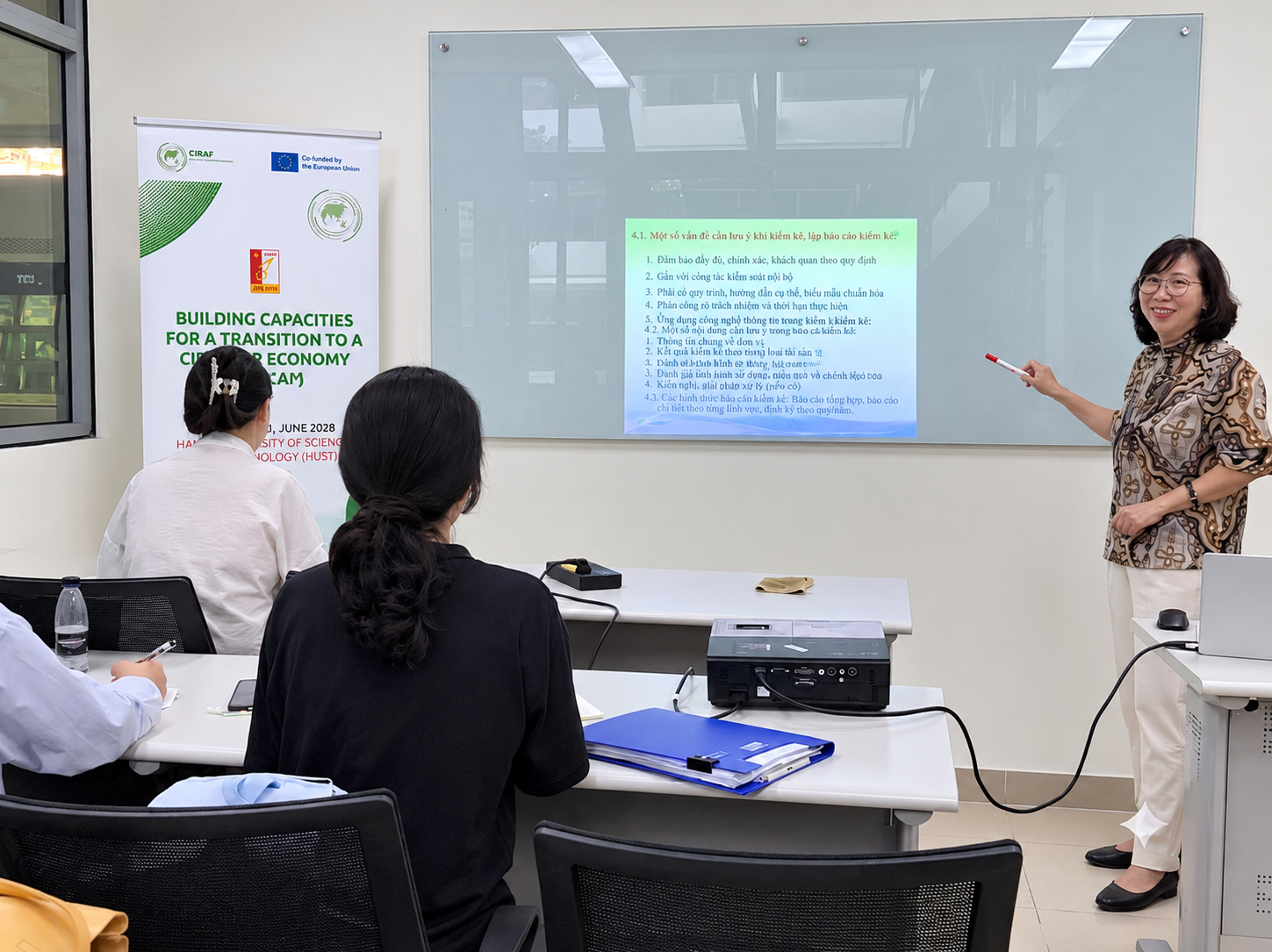
Assoc. Prof. Hoang Thi Thu Huong working through ecosystem modelling exercises
Combining classroom learning, practical activities and e-learning The programme combines classroom learning, practical activities and e-learning, delivered through project-based and problem-based learning. According to the programme information, each class accommodates up to 20 participants, and participants receive a certificate upon completion of the course.
First round complete, second round underway Following the first training round in July–September 2026, the programme continued with a second round from October to December 2026, and will continue with another training round in 2027. According to the announced schedule, the next registration period will take place in January 2027, with the training scheduled for February–April 2027.
Through these training activities, CEBCAT and Hanoi University of Science and Technology aim to contribute to capacity building and knowledge sharing on environmental measurement and ecosystem change assessment, supporting green policy development and the broader transition towards circular economic models.
Stay tuned for further updates from CEBCAT and HUST, and don't miss the next registration opportunity in January 2027!